- The Weekly Buzz 🐝 by Blossom
- Posts
- 🤑 Nvidia Eyes $1T in Sales As It Pivots to AI Operating System (US)
🤑 Nvidia Eyes $1T in Sales As It Pivots to AI Operating System (US)
Plus, Markets Tumble Again After New Threats Create a ‘Ticking-Time Bomb’ Of Uncertainty...

Maxwell Nicholson
March 22, 2026
MARKET RECAP
🩸 Markets Tumble For 4th Week with ‘Ticking-Time Bomb’ Of Uncertainty

🤖 It’s the 4th week in a row of very rough markets, as the US-Iran war continues to escalate…
The S&P 500 fell another 1.9%, now down -5.1% year-to-date
The Nasdaq-100 fell 2%, now down -5.2% year-to-date
✨ I realize since the war started, it’s been 4 weeks of pretty negative headlines, so instead of going on and on about the doom-and-gloom this week, I want to shift gears to some of the exciting updates in the AI world: from Nvidia’s announcements at its GPU Tech Conference (GTC), Micron’s incredible earnings, and what it all means for the market at large.
🤿 But before we dive in there, let me give a quick recap of the big picture this week (buckle up for some more bad news 😢):
💣 The US-Iran War Escalates With A ‘Ticking Time Bomb’ of Uncertainty
😰 Investors have been hopeful for a quick resolution to the war, but on Friday, those hopes evaporated quickly after the WSJ reported that the Pentagon is sending thousands of Marines to the Middle East and that “heavy preparations” were being made for sending ground troops to Iran.
🩸And while the market has fallen a lot, many analysts believe troops on the ground could cause the pain to continue:
“If this is an escalation involving troops on the ground, then we’re probably in for at least a couple more weeks of this sort of market of higher oil prices.... Quite frankly, equity markets haven’t sold off in a way that would reflect this sort of event yet, so there could still be some downside ahead.”
📉 Another analyst adds that:
“It’s not unusual in the environment we’re in, with the amount of uncertainty we have, to have a 10% correction in any index”
😬 Threats back and forth between the US and Iran have also been heating up, with Trump threatening last night to “obliterate” Iran’s power plants if Iran doesn’t fully reopen the Strait of Hormuz within 48 hours. In response, Iran’s Revolutionary Guards said that:
“The Strait of Hormuz will be completely closed and will not be opened until our destroyed power plants are rebuilt”
⏰ One IG market analyst calls this a “48-hour ticking time bomb of uncertainty” and expects markets to fall when they reopen tomorrow.
🏦 Fed Holds Interest Rates Steady
🗞️ The other big macro news in the markets this week was the Fed’s decision to leave interest rates unchanged (bad news for the stock market since interest rate cuts usually help boost stock prices).
😵💫 The Fed is stuck in a pretty tough spot right now. On one hand, the slowing economy is a perfect time for a rate cut. But with oil prices climbing, the risk of runaway inflation is heightened…
😰 This has led to a new fear: that the Fed’s next move could be an interest rate increase. According to the Wall Street Journal, if oil keeps surging and inflation stays sticky, the Fed could actually have to consider raising rates again, which would be a major negative surprise for stocks (as if we needed more bad news).
That said, not everyone thinks this is likely. In a Friday note, Morgan Stanley’s chief U.S. economist called rising fears of rate hikes this year “overdone,” saying:
“Our outlook for two Fed rate cuts stands in stark contrast to current market pricing, which has hints of rate hikes.”
📉 Overall, the picture still isn’t pretty: war uncertainty is rising, oil prices are surging, and the Fed doesn’t have an easy way to step in and calm markets like investors might hope.
⚠️ That likely means the market could continue to fall in the short term, especially if the conflict worsens or inflation data starts moving in the wrong direction, so make sure you and your portfolio are prepared for a bit of a bumpy road ahead and keep the long-term view in mind
💡One thing that’s helped me is switching to the 1-year chart. Even though it’s tough to see red for 4 weeks in a row, the S&P 500 is still up 12.8% over the past year, which is still really strong returns despite what feels like a massive drop…
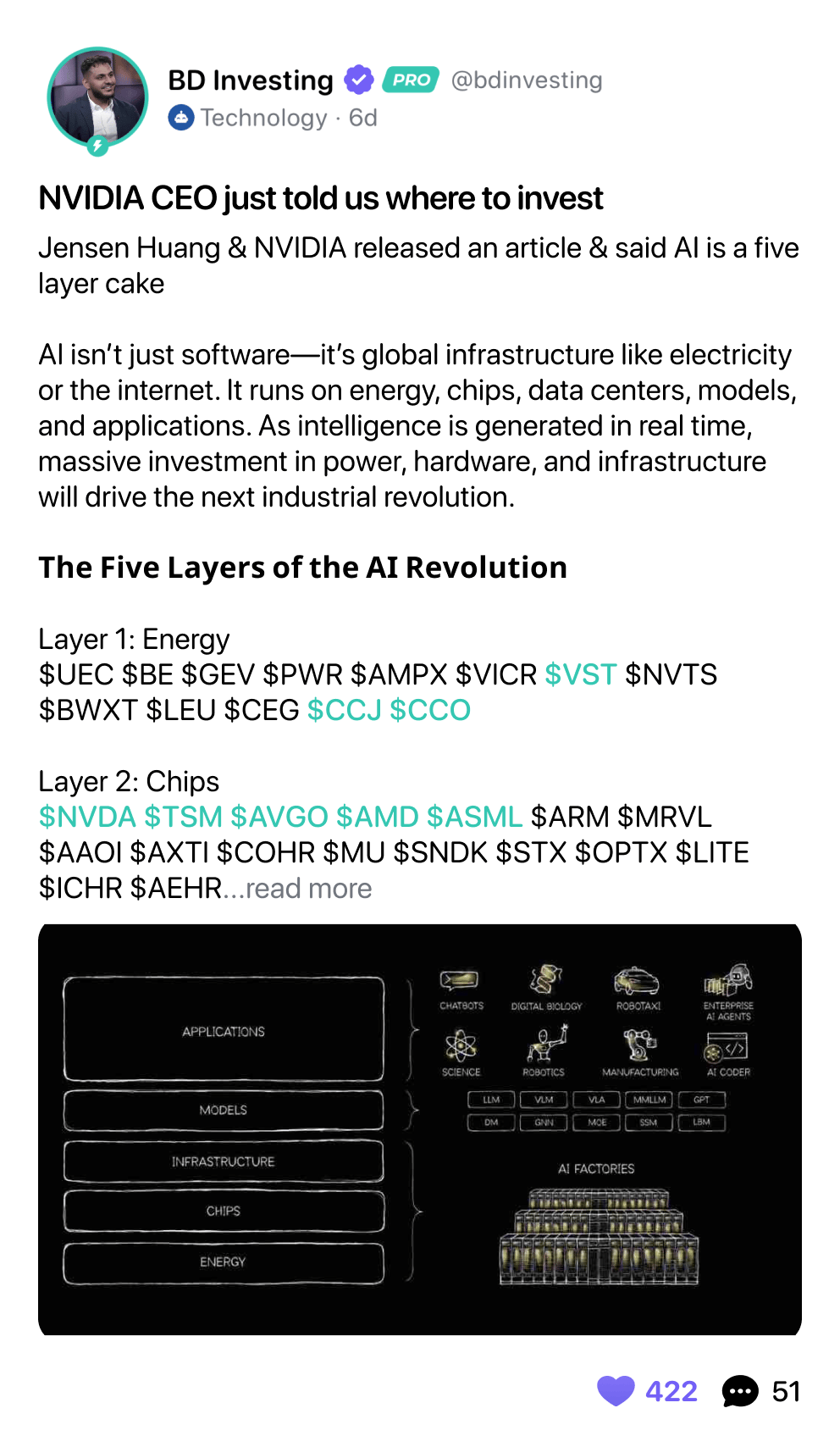
🤖 Alright, with the bad news out of the way, let’s switch to something a bit more exciting: some of the big updates coming out of Nvidia’s tech conference this week!
😎 But first, a quick work from this week’s sponsor State Street Global Advisors!
ANNOUCEMENT
🤝 We’ve Partnered With State Street for the #MyStory Contest!

📊 In case you haven’t heard of them, State Street Global Advisors are the architects behind the popular SPY ETF, which in addition to being a great way to track the S&P 500, is also the world’s most traded ETF, trading $52.57 billion a day!
🤝 SPY (and State Street) has been an important part of many investors’ stories, which is why I’m excited to share that State Street is our sponsor this year for the annual #MyStory contest on Blossom!
🎁 To enter, all you have to do is share your investing story in the #MyStory topic on Blossom, and you’ll get entered to win some sweet prizes.
TOP STORY
🤑 Nvidia Eyes $1T in Sales by 2027 as It Pivots from Chips to AI Operating System

✨ Despite four brutal weeks in the market and the US-Iran war dominating headlines, on the AI front, there was a lot to cheer for…
🤖 Nvidia's annual GPU Technology Conference (GTC) in San Jose drew 30,000+ attendees, with lines of people waiting to take photos with server racks. Micron reported one of its most impressive earnings reports to date, with revenue up nearly 200% year-over-year.
✨ So let's break down the big themes from GTC, Micron's blowout earnings, and what they mean for the AI market overall…
👀 Jensen’s New Play: From Chipmaker to AI Operating System
💰 The GTC conference started with a huge announcement, with Jensen Huang telling investors that he expects purchase orders for Blackwell and Vera Rubin chip to reach $1 trillion through 2027, more than double the company’s $500 billion projection from just a year ago.
🦞 But the biggest story from GTC wasn't a new chip, it was a new product called NemoClaw, an open-source, chip-agnostic platform for building and deploying AI agents.
🤖 NemoClaw is built on top of OpenClaw, the open-source AI agent that went viral earlier this year and became what Huang called "definitely the next ChatGPT", and the fastest-growing open-source project in history.
💡 The strategy is simple: NemoClaw is free. Huang isn't charging for the software layer, he's giving it away. But as adoption increases, Nvidia makes money on the chips and compute every AI agent needs to run.
💬 Huang made the mission clear at GTC:
“Every company in the world should have an agentic system strategy. This is the new computer now."
🏆 If this sounds familiar, it's because it's the same playbook Google ran with Android. You give away the layer that drives adoption, and monetize the infrastructure beneath it. If Huang pulls this off, Nvidia stops being a chipmaker that sells into commodity cycles and becomes a platform company that compounds.
😰 Why Nvidia Needs a New Moat
🤔 Nvidia's moat in the training era of AI, when companies were racing to build the biggest, most powerful models, was nearly impenetrable. Its chips and software ecosystem were so embedded in how AI models are built that switching to a competitor was nearly impossible.
⚠️ But the industry is shifting. The next wave isn't training new giant models, it's inference: running those models constantly, in real-world applications, at the lowest possible cost. And for inference, the lock-in is much weaker. Google, Amazon, and Broadcom are all building their own inference-tailored chips. The moat that made Nvidia the most valuable company in the world is thinning.
💬 As CNBC put it this week:
The question investors should be asking isn't whether NemoClaw works tomorrow. It's whether Nvidia is still a chipmaker or an operating system. One sells into cycles, the other compounds.
🚀 The Trillion-Dollar Token Economy
💡 And if Nvidia can successfully become the operating system, the potential could be massive, with Huang introducing the concept of "token economics" as a framework to think about AI value.
🔢 Basically, Huang explained that tokens are the basic unit of AI output (it takes about 1,300 tokens to generate 1,000 words of text). The key metric is cost per token. And as long as Nvidia's chips keep producing tokens at the lowest cost per unit, and demand for tokens continues to far outstrip supply, the AI boom rolls on.
🤖 And demand is accelerating fast. Reasoning AI models like OpenAI's o1 perform far more work to arrive at answers, consuming dramatically more tokens per task. Add AI agents on top of that, which run autonomously across multi-step workflows, and token consumption per user could multiply by 10x or 100x compared to a simple chatbot prompt.
🧐 But even this logic isn’t without critics, with some analysts pointing out that token prices have collapsed 99%+ in two years, increasing fears of commoditization that are likely at least in part to blame for Nvidia’s 4% drop this week.
📉 Micron Falls 10% Despite “Exceptional” Earnings
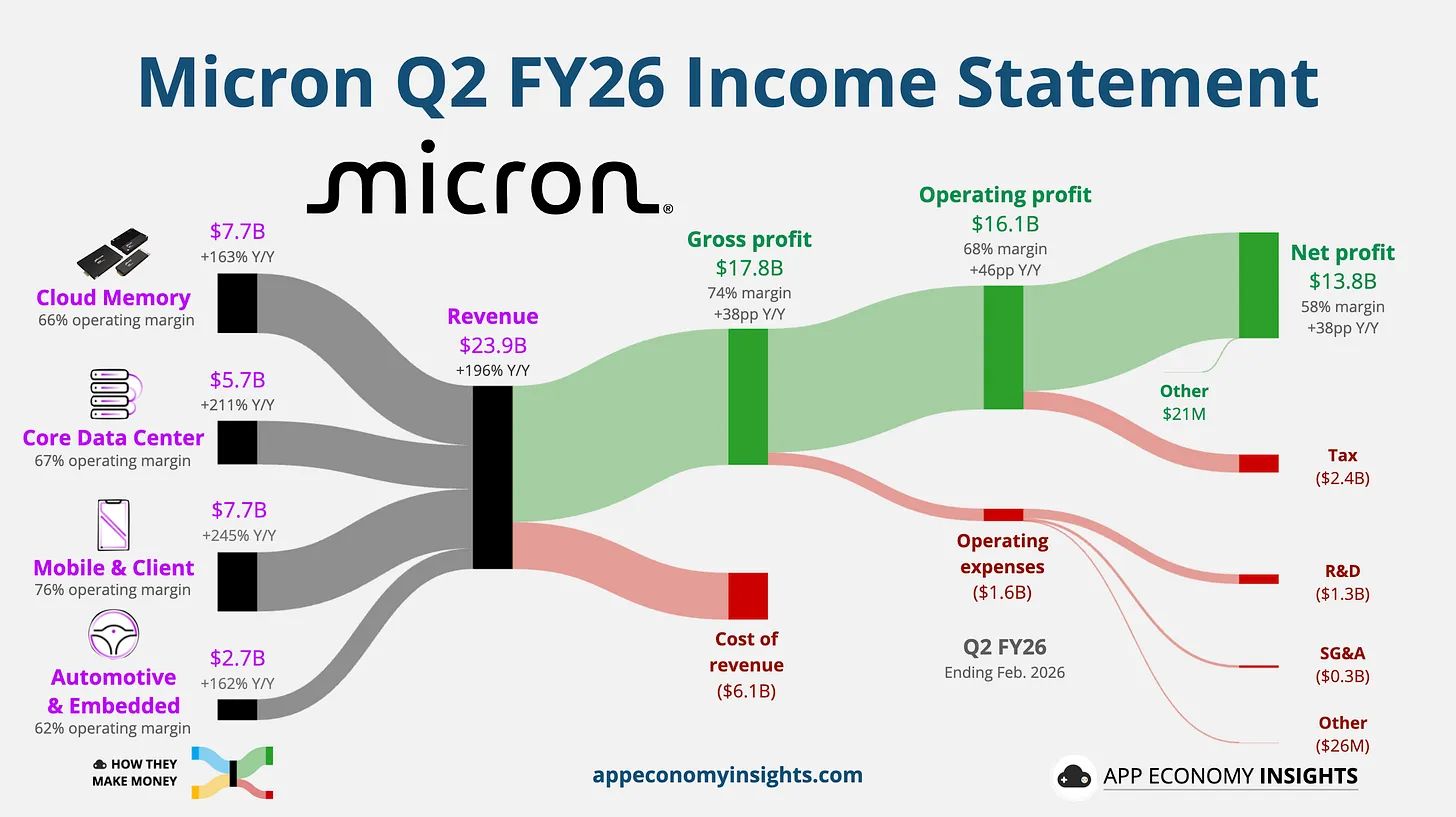
📊 Two days after Nvidia’s GTC on Monday, Micron ($MU), one of the most popular AI chip stocks in the market, reported exceptional Q2 FY2026 earnings, but saw its stock drop 10% over the week.
By the numbers:
✅ Revenue hit $23.9 billion vs. $20.0 billion expected, up 196% year-over-year
✅ Earnings per share hit $12.20 vs $9.19 expected, up 757% year-over-year
🔥 One writer at Barron’s called the results “exceptional,” and analysts remain very bullish, with 25 of the 27 analysts covering the stock on TipRanks maintaining buy ratings.
💡In fact, the demand is so strong that Micron has been struggling to keep up, with the CEO saying:
We are only able to supply, for our key customers in the midterm, about 50% to two-thirds of their requirements.
🤔 So why the drop? The concern is capital intensity. Meeting this level of AI demand requires massive ongoing investment, and investors are increasingly asking the same question they're asking all of Big Tech: how much value is left for shareholders after all the spending?
💡 AI Is Still Booming, But the Bar Has Been Raised.
🔮 Across all of this week's AI news, one theme runs through everything: AI adoption is accelerating, not slowing. The infrastructure spending is flowing through the whole supply chain.
⭐️ But investors are done being wowed by roadmaps. Three years into the AI era, they want proof that spending produces durable profits, defensible moats, and real returns on capital.
🍏 In some ways, this is healthy for AI. It means investors are shifting focus from headlines and announcements and focusing more on fundamentals and execution.
🔍 And again… if we zoom out, this week’s blip is basically a rounding error, with Micron still up a massive 336% over the past year and Nvidia up 42%.
📰 Ok, I’ve already covered a lot today, but there’s one more big story that’s worth taking a quick look at, and that’s Alibaba, which crashed 11% after earnings showed profits fell 67%.
😎 But before we cover our last story of the day, a quick word from our other sponsor this week, Mogul!
Experts Would Invest $100,000 in This Alternative Now
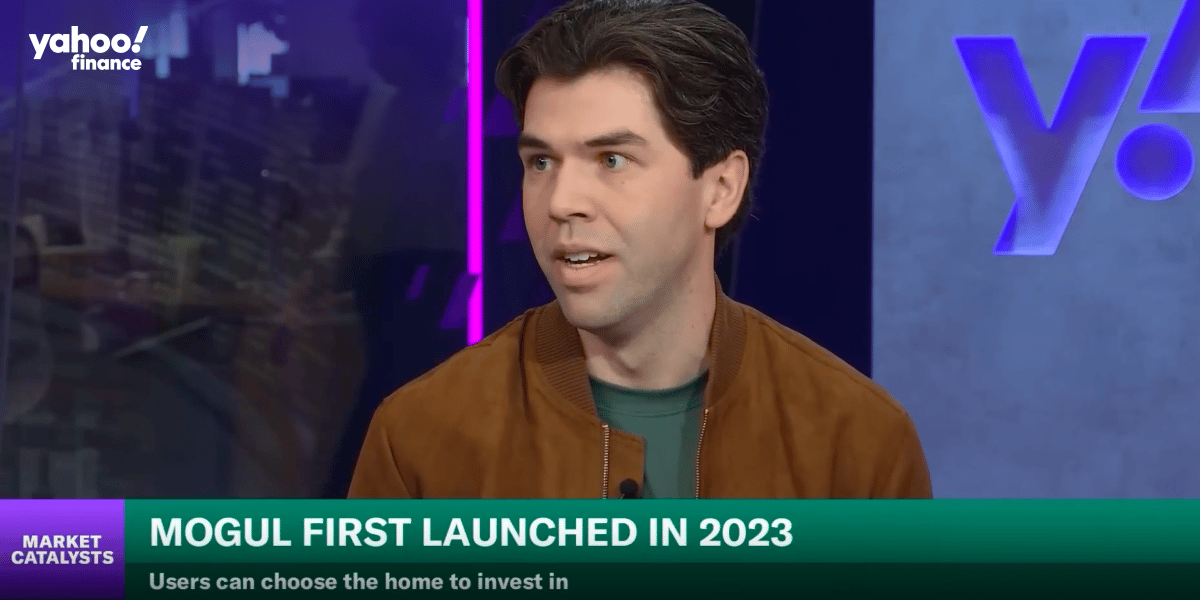
A new report shows 44% of family offices are investing more in residential real estate. Now, you can access these assets with mogul. This platform lets you invest in properties producing +7% yields and 18% IRRs. Plus, they do all the property management for you.
Past performance isn't predictive; illustrative only. Investing risks principal; no securities offer. See important Disclaimers
EARNINGS RECAP
📉 Alibaba Crashes 11% After Profits Plummet 67%, But Wall Street Is Still Buying

😰 On the surface, Alibaba's ($BABA) Q3 earnings report looks like a disaster. By the numbers:
❌ Revenue came in at $40.7 billion, up just 2% year-over-year, missing analyst expectations
❌ Non-GAAP net income fell 67% year-over-year to $2.39 billion
❌ Adjusted earnings per share (ADS) sank 67% to $1.01, badly missing estimates
🤔 But despite the rough numbers, analysts at Goldman, Morgan Stanley, and BofA are all essentially telling their clients to buy the dip… but why?
🚀 Cloud Revenue Soars 36%
🤖 While the headline numbers were rough, Alibaba’s AI story showed a lot of promise. This quarter, Alibaba's Cloud Intelligence Group posted revenue of $6.19 billion, up 36% year-over-year (outpacing growth rates of AWS, Google Cloud, and Azure).
📈 More striking: AI-related product revenue posted triple-digit growth for the 10th consecutive quarter in a row.
⭐️ Alibaba's open-source Qwen model has now hit 1 billion cumulative downloads. The Qwen app crossed 300 million monthly active users as of February, and BABA now estimates more than $100 billion in external AI and cloud revenue within five years.
Like many tech companies, Alibaba is going all in on AI, with the CEO putting it plainly, saying:
“AI is and will continue to be one of our primary growth engines.”
🎯Analyst Reactions

💡 The key question is whether this profit collapse is a sign of structural weakness, or just the cost of doing business during a heavy investment cycle.
⭐️ Well, according to analysts, it’s the latter, with most analysts maintaining aggressive price targets for the stock:
🎯 Morgan Stanley reiterated an Overweight rating and a $180 price target, with analyst Gary Yu noting the results show "explosive AI demand from strong token usage" and that the biggest takeaway is a "strengthened commercialization of AI across model capabilities, MaaS, and agentic applications."
🎯 BofA maintained a Buy rating and $180 target, with analyst Joyce Ju calling the e-commerce softness "expected" given the macro environment.
🎯 Citi has the most aggressive target on the Street at $200, calling the cloud acceleration a "positive note." With BABA trading around $124.90 at the time of writing, that implies roughly 60% upside from current levels.
💬 The broader Wall Street consensus has Alibaba at a strong buy, with an average price target of $187 (over 50% upside from current price). Goldman summed up the bull thesis best, noting that the profit decline reflects "higher reinvestment, not weaker demand", and that the spending is a strategic bet, not a distress signal.
🌎 The Bigger Picture: A Rough Patch for Chinese Tech
😰 BABA's drop isn't happening in isolation. The broader Chinese tech sector has been getting hammered, with the CHQQ China ETF (one of my personal holdings) down 19% year-to-date.
🇨🇳 Personally, I’m with the analysts on this one and am still bullish on Chinese tech and AI (as you can see from my ~6% position in CHQQ and 3% in BABA), but Chinese tech carries a lot of risk and uncertainty and definitely isn’t for the faint of heart.
✨ If I have time this week, I’ll try to share more of my perspective on Blossom, so make sure you drop me a follow if you haven’t already, but since this edition of the Buzz has already gotten quite long, I’ll wrap it up there and end off with our Top Discussion of the week 😊
FROM THE BLOSSOM COMMUNITY
⭐️ Top Discussions of the Week
👇 Click to see the full post!